Request Free Sample ×

Kindly complete the form below to receive a free sample of this Report

* Please use a valid business email

Leading companies partner with us for data-driven Insights

clients tt-cursor
Hero Background

Wireless Fire Detection System Market

ID: MRFR/SEM/2355-HCR
100 Pages
Nirmit Biswas
March 2026

Wireless Fire Detection System Market Size, Share and Research Report By Product (Panel, Siren, Smoke Detector, Repeater), By System Type (Fully Wireless Systems, Hybrid Systems), By End-User (Education, Residential, Healthcare, Government, Others), And By Region (North America, Europe, Asia-Pacific, And Rest Of The World) – Industry Forecast Till 2035

Share:
Download PDF ×

We do not share your information with anyone. However, we may send you emails based on your report interest from time to time. You may contact us at any time to opt-out.

Wireless Fire Detection System Market Infographic
Purchase Options

Wireless Fire Detection System Market Summary

As per MRFR analysis, the Wireless Fire Detection System Market Size was estimated at 5.58 USD Billion in 2024. The Wireless Fire Detection System industry is projected to grow from 6.13 in 2025 to 15.67 by 2035, exhibiting a compound annual growth rate (CAGR) of 9.84% during the forecast period 2025 - 2035.

Key Market Trends & Highlights

The Wireless Fire Detection System Market is experiencing robust growth driven by technological advancements and increasing safety awareness.

  • Technological advancements are enhancing the efficiency and reliability of wireless fire detection systems.
  • Integration with smart technologies is becoming a prevalent trend, facilitating seamless communication and control.
  • North America remains the largest market, while Asia-Pacific is emerging as the fastest-growing region in this sector.
  • The increased demand for safety solutions and regulatory compliance are key drivers propelling market expansion.

Market Size & Forecast

2024 Market Size 5.58 (USD Billion)
2035 Market Size 15.67 (USD Billion)
CAGR (2025 - 2035) 9.84%

Major Players

Honeywell (US), Johnson Controls (US), Siemens (DE), Bosch Security Systems (DE), Tyco International (IE), Schneider Electric (FR), UTC Fire & Security (US), Apollo Fire Detectors (GB), System Sensor (US)

Our Impact
Enabled $4.3B Revenue Impact for Fortune 500 and Leading Multinationals
Partnering with 2000+ Global Organizations Each Year
30K+ Citations by Top-Tier Firms in the Industry

Wireless Fire Detection System Market Trends

The Wireless Fire Detection System Market is currently experiencing a notable transformation, driven by advancements in technology and an increasing emphasis on safety protocols across various sectors. The integration of wireless technology into fire detection systems enhances their efficiency and reliability, allowing for quicker response times and reduced installation complexities. This shift is particularly evident in commercial buildings, industrial facilities, and residential areas, where the demand for seamless and effective fire safety solutions is paramount. Furthermore, the growing awareness of fire hazards and the need for compliance with stringent safety regulations are propelling the adoption of these systems. As organizations prioritize risk management, the Wireless Fire Detection System Market is poised for substantial growth. In addition to technological advancements, the market is also influenced by the rising trend of smart buildings and the Internet of Things (IoT). The convergence of fire detection systems with smart technologies enables real-time monitoring and data analytics, which can significantly enhance fire safety measures. This integration not only improves operational efficiency but also provides valuable insights for preventive maintenance. As the market evolves, stakeholders are likely to focus on developing innovative solutions that cater to the unique needs of various industries, thereby fostering a competitive landscape that encourages continuous improvement and adaptation to emerging challenges.

Technological Advancements

The Wireless Fire Detection System Market is witnessing rapid technological advancements that enhance system capabilities. Innovations in sensor technology and communication protocols are leading to more reliable and efficient fire detection solutions. These advancements facilitate quicker response times and improved accuracy in identifying fire hazards.

Integration with Smart Technologies

The trend of integrating fire detection systems with smart technologies is gaining traction. This integration allows for real-time monitoring and data analytics, which can significantly enhance fire safety measures. As buildings become smarter, the demand for interconnected fire detection solutions is likely to increase.

Regulatory Compliance and Safety Awareness

There is a growing emphasis on regulatory compliance and safety awareness within various industries. Organizations are increasingly prioritizing fire safety measures to adhere to stringent regulations. This heightened focus on compliance is driving the adoption of advanced wireless fire detection systems.

Wireless Fire Detection System Market Drivers

Growing Urbanization

Urbanization is a significant driver of the Global Wireless Fire Detection System Market Industry. As populations migrate to urban areas, the demand for residential and commercial buildings increases, necessitating effective fire safety solutions. High-density living environments, such as apartment complexes and office buildings, require advanced fire detection systems to ensure occupant safety. The increasing number of high-rise buildings in metropolitan areas further amplifies this need. Consequently, the market is likely to experience a compound annual growth rate of 9.84% from 2025 to 2035, as urban development continues to accelerate.

Market Growth Projections

The Global Wireless Fire Detection System Market Industry is poised for substantial growth, with projections indicating a market value of 5.58 USD Billion in 2024 and an anticipated rise to 15.7 USD Billion by 2035. This growth trajectory suggests a compound annual growth rate of 9.84% from 2025 to 2035. Such figures reflect the increasing adoption of advanced fire detection technologies across various sectors, driven by factors such as regulatory compliance, technological advancements, and rising awareness of fire safety. The market's expansion is indicative of a broader trend towards enhanced safety measures in both residential and commercial environments.

Technological Advancements

Technological innovations play a pivotal role in the expansion of the Global Wireless Fire Detection System Market Industry. The integration of Internet of Things (IoT) technology into fire detection systems enhances their efficiency and reliability. Smart sensors and real-time monitoring capabilities allow for quicker response times and improved accuracy in detecting fires. For example, systems that utilize machine learning algorithms can analyze patterns and reduce false alarms. This trend is expected to contribute to the market's growth, with projections indicating a rise to 15.7 USD Billion by 2035, driven by continuous advancements in technology.

Increasing Safety Regulations

The Global Wireless Fire Detection System Market Industry is experiencing growth due to the rising implementation of stringent safety regulations across various sectors. Governments worldwide are mandating advanced fire safety measures, which include the adoption of wireless fire detection systems. These regulations aim to enhance safety in commercial buildings, industrial facilities, and residential areas. For instance, the National Fire Protection Association has established codes that encourage the use of modern fire detection technologies. As a result, the market is projected to reach 5.58 USD Billion in 2024, reflecting a growing emphasis on compliance with safety standards.

Rising Awareness of Fire Safety

There is a growing awareness of fire safety among consumers and businesses, which is positively impacting the Global Wireless Fire Detection System Market Industry. Educational campaigns and training programs emphasize the importance of fire prevention and detection. This heightened awareness leads to increased investments in fire safety technologies, including wireless systems that offer enhanced features and flexibility. For instance, businesses are increasingly recognizing the cost-effectiveness of wireless systems, which can be installed with minimal disruption. This trend is expected to drive market growth, as more stakeholders prioritize fire safety in their operations.

Integration with Smart Building Technologies

The integration of wireless fire detection systems with smart building technologies is emerging as a key driver in the Global Wireless Fire Detection System Market Industry. As buildings become more automated, the need for interconnected systems that communicate seamlessly is paramount. Wireless fire detection systems can be integrated with other smart technologies, such as HVAC and security systems, to provide comprehensive safety solutions. This synergy not only enhances fire safety but also improves overall building management efficiency. The market is anticipated to benefit from this trend, as more developers and property managers seek to implement smart building solutions.

Market Segment Insights

By Application: Commercial (Largest) vs. Healthcare (Fastest-Growing)

The Wireless Fire Detection System Market is categorically segmented into residential, commercial, industrial, transportation, and healthcare applications. Among these, the commercial sector commands the largest market share due to its extensive use of advanced fire safety systems in office buildings, retail spaces, and other commercial establishments. The residential segment holds a notable share as well, yet its growth is considerably slower compared to the commercial application. The industrial sector presents a moderate share, while transportation and healthcare sectors follow, each contributing uniquely to the market dynamics.

Commercial: Dominant vs. Healthcare: Emerging

The commercial application of wireless fire detection systems is the dominant player in the market, characterized by its widespread adoption in diverse scenarios such as offices, shopping malls, and warehouses. Businesses increasingly recognize the importance of fire safety, driving constant upgrades in technology and system features. In contrast, the healthcare segment is emerging as a significant area of growth, propelled by heightened safety regulations and the critical need for efficient fire protection in hospitals and care facilities. This segment is rapidly innovating with smart technologies to improve response times and enhance safety protocols, particularly essential in high-risk environments where patient safety is a priority.

By End Use: Fire Safety Services (Largest) vs. Construction (Fastest-Growing)

In the Wireless Fire Detection System Market, Fire Safety Services lead the segment distribution, reflecting a strong emphasis on proactive safety measures across various industries. This segment encompasses a wide array of applications, including installed systems and maintenance services, which contribute significantly to overall market share. Construction follows closely, as emerging trends in building safety regulations push for more integrated fire detection solutions at construction sites.

Fire Safety Services (Dominant) vs. Construction (Emerging)

Fire Safety Services remain a dominant force within the industry, driven by strict regulations and an increasing awareness of the need for enhanced safety protocols. This segment comprises fire protection systems and emergency response services, essentially making it indispensable in high-risk environments. In contrast, the Construction segment is emerging rapidly due to the ongoing infrastructure developments and modernization efforts worldwide. There is a significant push to incorporate advanced wireless fire detection systems that ensure compliance with safety standards, alongside innovations aiming for faster installations and reduced costs.

By Technology: Wireless Sensor Networks (Largest) vs. Radio Frequency Identification (Fastest-Growing)

In the Wireless Fire Detection System Market, market share is predominantly held by Wireless Sensor Networks, which provide reliable and scalable solutions for fire detection across various applications. This segment benefits from advancements in sensor technology and increased adoption in commercial and industrial settings, leading to substantial market presence. Conversely, Radio Frequency Identification, while currently smaller in market share, is rapidly gaining traction due to its innovative applications in tracking and monitoring fire safety equipment and improving response time during fire emergencies.

Technology: Wireless Sensor Networks (Dominant) vs. Radio Frequency Identification (Emerging)

Wireless Sensor Networks serve as the dominant force in the Wireless Fire Detection System market, characterized by their ability to deliver comprehensive coverage and real-time monitoring capabilities. These networks integrate multiple sensors to provide a cohesive system that enhances responsiveness and accuracy in fire detection. In contrast, Radio Frequency Identification is an emerging technology that enhances asset tracking and inventory management in fire safety, offering a promising avenue for improving operational efficiencies and safety compliance. While Wireless Sensor Networks focus on detection, RFID technology brings additional value through its unique ability to streamline maintenance operations and ensure that all safety equipment is accounted for.

By Component: Smoke Detectors (Largest) vs. Heat Detectors (Fastest-Growing)

In the Wireless Fire Detection System Market, smoke detectors hold the largest market share, largely due to their critical role in fire safety and prevention. Their widespread adoption in residential and commercial settings underscores their importance and reliability. Following closely, heat detectors have emerged as a crucial segment, gaining traction thanks to advancements in technology and their integration with smart systems, which enhances their appeal in modern fire safety solutions.

Smoke Detectors (Dominant) vs. Heat Detectors (Emerging)

Smoke detectors are characterized by their essential function in early fire detection, leveraging technologies like photoelectric and ionization to sense smoke particles. Their established presence in both residential and commercial applications contributes significantly to their dominant market position. In contrast, heat detectors are rapidly emerging as a favored choice for specific environments where smoke detection may be compromised, such as kitchens or industrial areas. Their ability to function effectively under challenging conditions, combined with the growing trend towards smart fire safety solutions, positions them well for future growth in the market.

By Installation Type: New Installation (Largest) vs. Retrofit Installation (Fastest-Growing)

In the Wireless Fire Detection System Market, the installation type segmentation reveals that New Installation holds the largest share, driven by ongoing new construction projects in various sectors including commercial and residential buildings. Additionally, Retrofit Installation is gaining significant traction, appealing to existing structures that require modernization with advanced fire detection capabilities, marking its fast growth in market relevance.

New Installation (Dominant) vs. Retrofit Installation (Emerging)

New Installation is characterized by its preference in building projects where innovative systems are sought, offering comprehensive, state-of-the-art solutions tailored for expanded safety protocols. On the other hand, Retrofit Installation has emerged as a crucial option for older buildings, providing an upgrade to current safety standards without the need for complete structural changes. This segment addresses the unique needs of older facilities looking to enhance their safety systems effectively and economically. The dynamic between both fixtures highlights a responsive market adapting to evolving safety regulations and technological advancements.

Get more detailed insights about Wireless Fire Detection System Market

Regional Insights

North America : Market Leader in Innovation

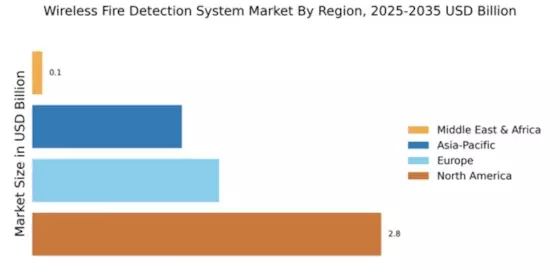
North America continues to lead the Wireless Fire Detection System market, holding a significant share of 2.8 billion in 2024. The region's growth is driven by stringent safety regulations, increasing awareness of fire safety, and technological advancements in wireless systems. The demand for smart building solutions and integration with IoT technologies further propels market expansion. Regulatory bodies are emphasizing the need for enhanced fire safety measures, which is expected to boost market growth in the coming years. The competitive landscape in North America is robust, featuring key players such as Honeywell, Johnson Controls, and UTC Fire & Security. These companies are investing heavily in R&D to innovate and improve their product offerings. The presence of advanced manufacturing facilities and a strong distribution network enhances their market position. As the region continues to prioritize safety and efficiency, the Wireless Fire Detection System market is poised for sustained growth.

Europe : Emerging Regulatory Frameworks

Europe's Wireless Fire Detection System market is valued at 1.5 billion, reflecting a growing emphasis on safety regulations and standards. The region is witnessing increased demand for advanced fire detection technologies, driven by rising urbanization and the need for enhanced safety in commercial and residential buildings. Regulatory frameworks are evolving, with initiatives aimed at improving fire safety standards across member states, which is expected to further stimulate market growth. Leading countries in this region include Germany, France, and the UK, where companies like Siemens and Bosch Security Systems are prominent. The competitive landscape is characterized by a mix of established players and innovative startups, all striving to meet the stringent safety requirements. The presence of key players and a focus on technological advancements position Europe as a significant market for wireless fire detection systems.

Asia-Pacific : Rapid Growth in Emerging Markets

The Asia-Pacific region, valued at 1.2 billion, is experiencing rapid growth in the Wireless Fire Detection System market. This growth is fueled by increasing urbanization, industrialization, and a rising awareness of fire safety among consumers and businesses. Governments are implementing stricter regulations to enhance fire safety standards, which is driving demand for advanced fire detection solutions. The region's diverse market dynamics present both challenges and opportunities for growth in the coming years. Countries like China, India, and Japan are leading the charge in adopting wireless fire detection technologies. The competitive landscape features both global players and local manufacturers, with companies like Tyco International and Schneider Electric making significant inroads. As the region continues to develop, the demand for innovative fire safety solutions is expected to rise, further propelling market growth.

Middle East and Africa : Emerging Market Potential

The Middle East and Africa region, with a market size of 0.08 billion, presents emerging opportunities in the Wireless Fire Detection System market. The growth is driven by increasing investments in infrastructure and a rising focus on safety regulations. Governments are beginning to recognize the importance of fire safety, leading to the implementation of new standards and regulations. This shift is expected to create a favorable environment for market expansion in the coming years. Key countries in this region include the UAE and South Africa, where there is a growing demand for advanced fire detection systems. The competitive landscape is still developing, with a mix of local and international players. As awareness of fire safety increases, the market is likely to see more investments and innovations, paving the way for future growth.

Wireless Fire Detection System Market Regional Image

Key Players and Competitive Insights

The Wireless Fire Detection System Market is currently characterized by a dynamic competitive landscape, driven by technological advancements and an increasing emphasis on safety regulations across various sectors. Key players such as Honeywell (US), Johnson Controls (US), and Siemens (DE) are strategically positioned to leverage innovation and digital transformation to enhance their offerings. Honeywell (US) focuses on integrating advanced analytics and IoT capabilities into its fire detection systems, thereby improving response times and operational efficiency. Meanwhile, Johnson Controls (US) emphasizes partnerships with local authorities to ensure compliance with regional safety standards, which enhances its market presence. Siemens (DE) is also investing heavily in R&D to develop next-generation fire detection technologies, indicating a collective shift towards innovation as a primary competitive driver. The market structure appears moderately fragmented, with several players vying for market share through localized manufacturing and optimized supply chains. This fragmentation allows for a diverse range of products and services, catering to various customer needs. Companies are increasingly localizing their manufacturing processes to reduce lead times and enhance responsiveness to market demands. The collective influence of these key players shapes a competitive environment where agility and adaptability are paramount. In November 2025, Honeywell (US) announced the launch of its latest fire detection system, which incorporates AI-driven analytics to predict potential fire hazards before they escalate. This strategic move not only positions Honeywell as a leader in technological innovation but also addresses the growing demand for proactive safety measures in commercial buildings. The integration of AI is likely to enhance the system's reliability and effectiveness, thereby attracting a broader customer base. In October 2025, Siemens (DE) entered into a strategic partnership with a leading telecommunications provider to enhance the connectivity of its fire detection systems. This collaboration aims to integrate 5G technology into fire safety solutions, enabling real-time monitoring and faster response times. Such advancements are expected to significantly improve the operational capabilities of fire detection systems, reinforcing Siemens' competitive edge in the market. In September 2025, Johnson Controls (US) expanded its operations in the Asia-Pacific region by acquiring a local fire safety company. This acquisition is indicative of Johnson Controls' strategy to strengthen its foothold in emerging markets, where demand for advanced fire detection systems is on the rise. By localizing its operations, the company can better cater to regional safety regulations and customer preferences, thereby enhancing its market competitiveness. As of December 2025, the Wireless Fire Detection System Market is witnessing trends that emphasize digitalization, sustainability, and the integration of AI technologies. Strategic alliances among key players are increasingly shaping the competitive landscape, fostering innovation and enhancing product offerings. The shift from price-based competition to a focus on technological advancement and supply chain reliability is evident, suggesting that future competitive differentiation will hinge on the ability to innovate and adapt to evolving market demands.

Key Companies in the Wireless Fire Detection System Market include

Industry Developments

August 2021: Halma announced the acquisition of Ramtech, the UK market for wireless safety and security solutions. Ramtech will join several businesses in the safety and fire detection sectors that are currently represented in the portfolio of Halma plc.

Future Outlook

Wireless Fire Detection System Market Future Outlook

The Wireless Fire Detection System Market is projected to grow at a 9.84% CAGR from 2025 to 2035, driven by technological advancements, regulatory compliance, and increasing safety awareness.

New opportunities lie in:

  • Integration of IoT for real-time monitoring solutions.

  • Development of AI-driven analytics for predictive maintenance.
  • Expansion into emerging markets with tailored solutions.

By 2035, the market is expected to achieve substantial growth, reflecting evolving safety standards and technological innovations.

Market Segmentation

Wireless Fire Detection System Market End Use Outlook

  • Fire Safety
  • Building Management
  • Emergency Services
  • Insurance
  • Manufacturing

Wireless Fire Detection System Market Technology Outlook

  • Wireless Sensor Networks
  • Cloud-Based Systems
  • Mobile Applications
  • IoT Integration
  • Data Analytics

Wireless Fire Detection System Market Application Outlook

  • Residential
  • Commercial
  • Industrial
  • Transportation
  • Healthcare

Wireless Fire Detection System Market Component Type Outlook

  • Smoke Detectors
  • Heat Detectors
  • Control Panels
  • Notification Devices
  • Power Supply

Wireless Fire Detection System Market Installation Type Outlook

  • New Installation
  • Retrofit Installation
  • Integrated Systems
  • Standalone Systems
  • Modular Systems

Report Scope

MARKET SIZE 2024 5.58(USD Billion)
MARKET SIZE 2025 6.13(USD Billion)
MARKET SIZE 2035 15.67(USD Billion)
COMPOUND ANNUAL GROWTH RATE (CAGR) 9.84% (2025 - 2035)
REPORT COVERAGE Revenue Forecast, Competitive Landscape, Growth Factors, and Trends
BASE YEAR 2024
Market Forecast Period 2025 - 2035
Historical Data 2019 - 2024
Market Forecast Units USD Billion
Key Companies Profiled Honeywell (US), Johnson Controls (US), Siemens (DE), Bosch Security Systems (DE), Tyco International (IE), Schneider Electric (FR), UTC Fire & Security (US), Apollo Fire Detectors (GB), System Sensor (US)
Segments Covered Application, End Use, Technology, Component Type, Installation Type
Key Market Opportunities Integration of advanced sensors and IoT technology enhances efficiency in the Wireless Fire Detection System Market.
Key Market Dynamics Technological advancements and regulatory changes drive the adoption of wireless fire detection systems across various sectors.
Countries Covered North America, Europe, APAC, South America, MEA

Market Highlights

Author
Author
Author Profile
Nirmit Biswas LinkedIn
Senior Research Analyst
With 5+ years of expertise in Market Intelligence and Strategic Research, Nirmit Biswas specializes in ICT, Semiconductors, and BFSI. Backed by an MBA in Financial Services and a Computer Science foundation, Nirmit blends technical depth with business acumen. He has successfully led 100+ projects for global enterprises and startups, including Amazon, Cisco, L&T and Huawei, delivering market estimations, competitive benchmarking, and GTM strategies. His focus lies in transforming complex data into clear, actionable insights that drive growth, innovation, and investment decisions. Recognized for bridging engineering innovation with executive strategy, Nirmit helps businesses navigate dynamic markets with confidence.
Co-Author
Co-Author Profile
Aarti Dhapte LinkedIn
AVP - Research
A consulting professional focused on helping businesses navigate complex markets through structured research and strategic insights. I partner with clients to solve high-impact business problems across market entry strategy, competitive intelligence, and opportunity assessment. Over the course of my experience, I have led and contributed to 100+ market research and consulting engagements, delivering insights across multiple industries and geographies, and supporting strategic decisions linked to $500M+ market opportunities. My core expertise lies in building robust market sizing, forecasting, and commercial models (top-down and bottom-up), alongside deep-dive competitive and industry analysis. I have played a key role in shaping go-to-market strategies, investment cases, and growth roadmaps, enabling clients to make confident, data-backed decisions in dynamic markets.
Leave a Comment

FAQs

What is the projected market valuation of the Wireless Fire Detection System Market by 2035?

<p>The Wireless Fire Detection System Market is projected to reach a valuation of 15.67 USD Billion by 2035.</p>

What was the market valuation of the Wireless Fire Detection System Market in 2024?

<p>In 2024, the market valuation of the Wireless Fire Detection System was 5.58 USD Billion.</p>

What is the expected CAGR for the Wireless Fire Detection System Market during the forecast period 2025 - 2035?

<p>The expected CAGR for the Wireless Fire Detection System Market during the forecast period 2025 - 2035 is 9.84%.</p>

Which companies are considered key players in the Wireless Fire Detection System Market?

<p>Key players in the Wireless Fire Detection System Market include Honeywell, Johnson Controls, Siemens, and Bosch Security Systems.</p>

What are the projected valuations for the Residential segment by 2035?

<p>The Residential segment is projected to grow from 1.67 USD Billion to 4.67 USD Billion by 2035.</p>

How does the Commercial segment's valuation change from 2024 to 2035?

<p>The Commercial segment's valuation is expected to increase from 1.2 USD Billion in 2024 to 3.4 USD Billion by 2035.</p>

What is the anticipated growth for the Industrial segment in the Wireless Fire Detection System Market?

The Industrial segment is projected to grow from 1.1 USD Billion to 3.1 USD Billion by 2035.

What are the expected valuations for the Wireless Sensor Networks technology by 2035?

The Wireless Sensor Networks technology is expected to grow from 1.67 USD Billion to 4.67 USD Billion by 2035.

What is the projected growth for Smoke Detectors in the Wireless Fire Detection System Market?

Smoke Detectors are projected to increase from 1.67 USD Billion in 2024 to 4.67 USD Billion by 2035.

What is the expected valuation for the Transportation segment by 2035?

The Transportation segment is anticipated to grow from 0.8 USD Billion to 2.3 USD Billion by 2035.

Download Free Sample

Kindly complete the form below to receive a free sample of this Report

Compare Licence

×
Features License Type
Single User Multiuser License Enterprise User
Price $4,950 $5,950 $7,250
Maximum User Access Limit 1 User Upto 10 Users Unrestricted Access Throughout the Organization
Free Customization
Direct Access to Analyst
Deliverable Format
Platform Access
Discount on Next Purchase 10% 15% 15%
Printable Versions